Where do you go to get a savory pear chutney, a bouquet of zinnias, and a tasty bag of sprouted lentils? From Amandaland Farms at ALFN of course! Amanda Isbell is serving up uniquely delicious treats for our food club, and shared with us how and why she got into the microgreens game.
Amanda brings a warm presence to the local food scene!
Amanda:I’ve always loved to grow things, and I’ve always loved healthy food. Microgreens are where those interests come together. I am so amazed that all the energy that little plant needed was right there in that seed. I grow the microgreens on soil and keep them happily watered. They come out of their seed in the most beautiful ways. They are packed with nutrients and can be used anywhere you would use lettuce or spinach. I harvest them on the night before or the day of the market so they are super fresh! They are versatile, they are a nutrition powerhouse, and they are just darn cute. My favorite ways to eat them are:
Move over breakfast salsa, here comes pesto and microgreens
Pea shoot and zucchini salad with feta cheese and olive oil lemon dressing
Pea shoots sauteed with sesame oil and peppers – like a stir fry
Sunnie (sunflower shoots) on lettuce wraps, on tomato sandwiches, and in my salads
Microgreens in my morning smoothie – they are packed with vitamin C
I love them mostly in savory dishes, but I really did enjoy a pea shoot and Arkansas strawberry salad with a balsamic vinaigarette.
I also love the ALFN market! I love that it is non-profit and run by volunteers! I had so much fun talking with everyone, seeing the incredible products by the growers, and cheese makers, and bread bakers. I am really proud to be able to offer my microgreens through this venue.
Written by Tammy Pope, vendor representative on the ALFN Board and owner of Tammy Sue’s Critters
It’s September, and it really feels like fall. We have been busy in the kitchen whipping up some yummy concoctions with a bit of end of season produce. These side dishes go well with chicken, beef, or seafood. If you have about thirty minutes, you can indulge your taste buds in the deliciousness!
Squash
Ingredients:
3 summer squash, sliced in medallions
1 Tbsp sunflower oil
½ tsp oregano, dried
½ tsp basil, dried
Salt and pepper to taste
2 Tbsp parmesan cheese
Directions:
Turn on broiler
Sautee squash in oil until soft over medium heat.
Add in seasoning and stir well.
Sprinkle parmesan cheese on top.
Broil for 3-4 minutes until cheese is golden brown.
Fall is here! You can feel it in the air, and you can see it at the Farmer’s Market. This month will be the last of Summer’s sweet berries, but there’s still plenty to look forward to.
Local food supports the local economy – Your dollars go directly into the pockets of local growers and producers, and they in turn often reinvest the dollars in other local businesses.
Local food is fresher – ALFN growers pick food at its peak of ripeness to fill orders and deliver to local markets, while non-local fruits and vegetables can travel for days before they reach the store.
Local food is more nutritious – non-local foods lose nutrients over days of travel: eating food at its peak freshness also means eating food while it is still full of nutrients.
Local food is seasonal – which allows you to eat along with nature’s natural rhythms. Remember the sweetness of the first berry you eat in the spring or the comfort you feel when eating roasted squash in the fall? That’s the joy of seasonal eating!
Eating locally helps the environment – local food requires less fossil fuels to transport and generates fewer greenhouse gases.
Local food preserves food diversity – many ALFN producers offer Arkansas heritage and heirloom products that have been grown locally and preserved for generations.
You can know exactly where your food was raised and how it was processed – on the ALFN website, you can find information about our vendors’ farms and practices.
Eating locally allows you to get to know your food producers – many of our growers and producers offer farm or garden tours or classes.
Eating locally gives you the opportunity to try new foods! ALFN growers are able to produce smaller crops of unique fruits and vegetables that you don’t often see in stores like purple peppers, pea shoots, and purslane. Wondering what to do with a food product? Many producers share their favorite recipes on Facebook or upon request.
Eating locally promotes food safety – conventional food travels long distances and risks contamination along many points in its journey.
Local food tastes better. Don’t believe me? Order some fresh, seasonal, local food from our website and try for yourself!
I like to sleep in on Saturdays. That’s not a great pairing with also wanting to support local farmers markets and the whole “early bird gets the worm” thing. My support of ALFN started as a practical matter almost five years ago. When I realized I could sleep in on Saturdays and still buy fresh peaches and blueberries and lettuce and eggs from Arkansas farmers, I never looked back.
As I became a devoted shopper on ALFN, I also began to learn about the organization. I am deeply committed to supporting local farmers, artisans, and makers and bringing the same access to all is one of my chief concerns. I’ve enjoyed serving on ALFN’s board of directors for the last two years and learning even more about our mission. Knowing that my shopping habits support 25 families with the same fresh, local, and delicious foods that I buy each week, only sweetens the experience for me.
My husband and I enjoy our Saturday mornings and our locally sourced goods every week. For us, ALFN serves our lifestyle and our hearts at the same time.
Zucchinis are coming out our ears! Well, not really, thank goodness. But zucchinis are abundant this time of year. Besides zucchini bread, one of my favorite, and somewhat indulgent, ways to use up these green gems is to make zucchini “fries”.
Cut your zucchini into slices cross-wise or length-wise, whatever shape you prefer. If cross-wise, not too thin and if length-wise, not too thick.
Toss the zucchini in a little bit of flour – shake off any excess. Then dip into a beaten egg. Next dip into a bowl containing an even mix of breadcrumbs or Panko and grated parmesan.
You can pan fry in a bit of olive oil or bake on a pan coated with olive oil in a 350 degree oven until crispy, turning once midway for even browning. Then, eat up!
Volunteering to write this blog post gave me a chance to discover more about ALFN’s Saturday morning market volunteers (set-up 8 to 10:30 am or pick-up 10 am to 12 pm).
Here’s what I learned from the men and women volunteering this past Saturday:
One volunteer has been with us from the start (nearly a decade of volunteering); others were first-time volunteers.
Several volunteers come nearly every Saturday, others are more occasional volunteers.
Most volunteers were members before volunteering, but one just like volunteering so she just started helping out!
Volunteers ranged in age from 20-something to 60-something.
All of the volunteers love ALFN’s fresh, healthy food offerings and all enjoy the comradery of fellow volunteers, staff and shoppers.
Personally, I volunteer because online ordering helps me plan weekly meals, and I want ALFN to thrive in spite of increasing market pressure.
Talking with volunteers made me aware of others’ motivations such as:
Volunteers get to see ALFN’s products in person, know what looks good, are in-touch with seasonal produce, and are prepared for next-week’s order.
Showing up on Saturday mornings gives structure to the day, setting a good pace for the whole weekend.
Volunteers can select an incentive that covers their membership fees, or allows them to purchase something special. Volunteering is a way of contributing to the household (literally, “bringing home the bacon”).
Volunteers appreciate helping sustain local farm businesses. They strongly value ALFN’s farm and food suppliers and the web of local small business.
Volunteers gain insight into how the market works and like having a part in making it run smoothly.
Volunteers treasure meeting farmers who drop off foods early on Saturday.
Volunteers create happy community while working together. Volunteering is fun!
It is time high time to prepare a fall garden space. Most fall crops are planted late August through mid-October, so the sooner the soil is turned and amendments added, the better.
The heat. Even with the current break in the heat, this may the biggest barrier you face. Wear loose clothing (think baggy, thin, all-cotton dress shirt), bring along a bucket of ice water and a towel. Follow the shade. If it is still unbearable, make a large box fan your companion. It really helps.
Winter sun. Before you get started, envision the sun’s path during fall and winter. Right now, it is high in the sky as it moves east to west. Come fall, it will be low and southerly. Trees that then may put your garden in the shade might not be much of a problem once leaves have fallen, but that does not happen until November. Plants needs the bright, sunny days of October to size up before short day length slows them down in November.
Tools. You’ll need a spade and garden rake. I also recommend a short-handled mattock. A really good tiller may help, but to deeply turn the soil, you’ll need a spade or shovel. It’s a full-body workout, so you can skip going to the gym.
A mattock tool
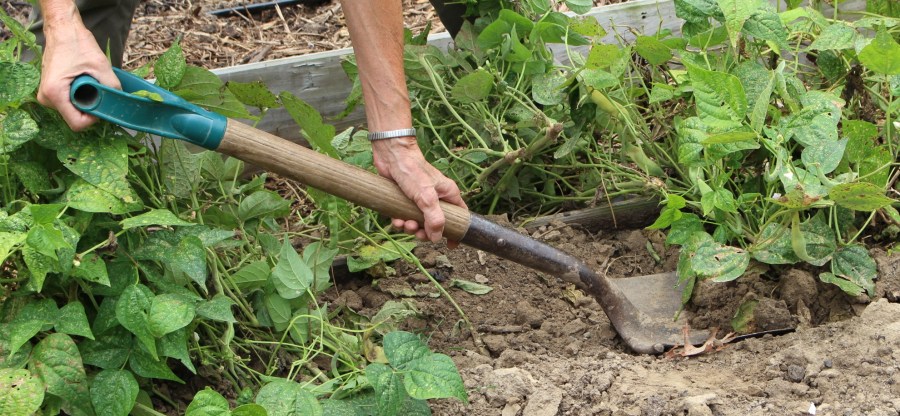
Clearing a bed. I once used a hoe to do this, but that created a mess of turned-up soil and weeds. One of the most valuable things I was taught at farmer school was how to “skim a bed.” To avoid churning up the soil as you work, attack weeds with a horizontal swipe of a spade, aiming the blade just below the soil surface. This separates a plant’s roots from its growth tip and top growth and renders most incapable of re-growth. Then rake away the chopped-off tops of plants. Use the mattock and spade to hack out the rest. If not too bulky, roots can stay (with the exception of Bermuda grass runners, which will re-grow). With the bed clear, you can now dig deeply (a foot at least) to loosen the soil. Then smooth the soil with a garden rake turned upside down. Take a breather and congratulate yourself.
Skimming a bed – a great arm workout!
Amendments. People write books on this topic. This hardly covers it. Did you get your soil tested? As a general rule, unless your garden’s soil is very fertile, compost won’t be enough to build strong, productive plants. You likely will need a source of more potent energy (think nitrogen) such as aged manure, blood meal, alfalfa meal, feather meal, fish emulsion, bat guano, or a commercial product. Your garden likely needs trace minerals (Azomite and kelp are sources) and lime to balance pH and add calcium, a critically important soil nutrient.
Mix all amendments together, broadcast, turn lightly, and rake smooth. Avoid displacing soil (and amendments) from one spot to the next. Water well to help amendments penetrate soil. If you are applying lime, it is best to do this several weeks before planting.
Planning. The U of A Cooperative Extension’s Year-Round Home Garden Planting Guide says what to plant in what month. Some plants do best by directly sowing seed; others do best as transplants (allow about a month to get them started). I recommend:
Direct sow: carrots, radishes, parsnips, turnips, spinach, and salad mix
Transplants: broccoli, cabbage, kohlrabi, collards. Scallions do much better as transplants but need about six weeks before moving to the garden. They will still be tiny, but they are very tough, so don’t worry if the soil falls off their roots during the process. Just stick them in the ground.
Either approach: kale, beets, mustard, lettuce, but any have a better chance as transplants
Try to get carrot seed (pelleted seed is worth it) in the ground late August to mid-September. Carrots need the abundant photons of the still-long days of early fall to bulk up. That is probably also true for other root crops. The greens can go in a bit later.
Moisture. For seeds to sprout, they need consistent moisture. That generally means watering twice a day. Don’t drown them. Even if the soil still looks moist in the morning from the watering the night before, seeds in a sunny spot will need more before the day is over. This is most true of carrot seed.
Gardening books. Check out Gardening When It Counts: Growing Food in Hard Times by Steve Solomon and The Book of Garden Secrets by Diane E. Bilderback and Dorothy Hinshaw Patent.
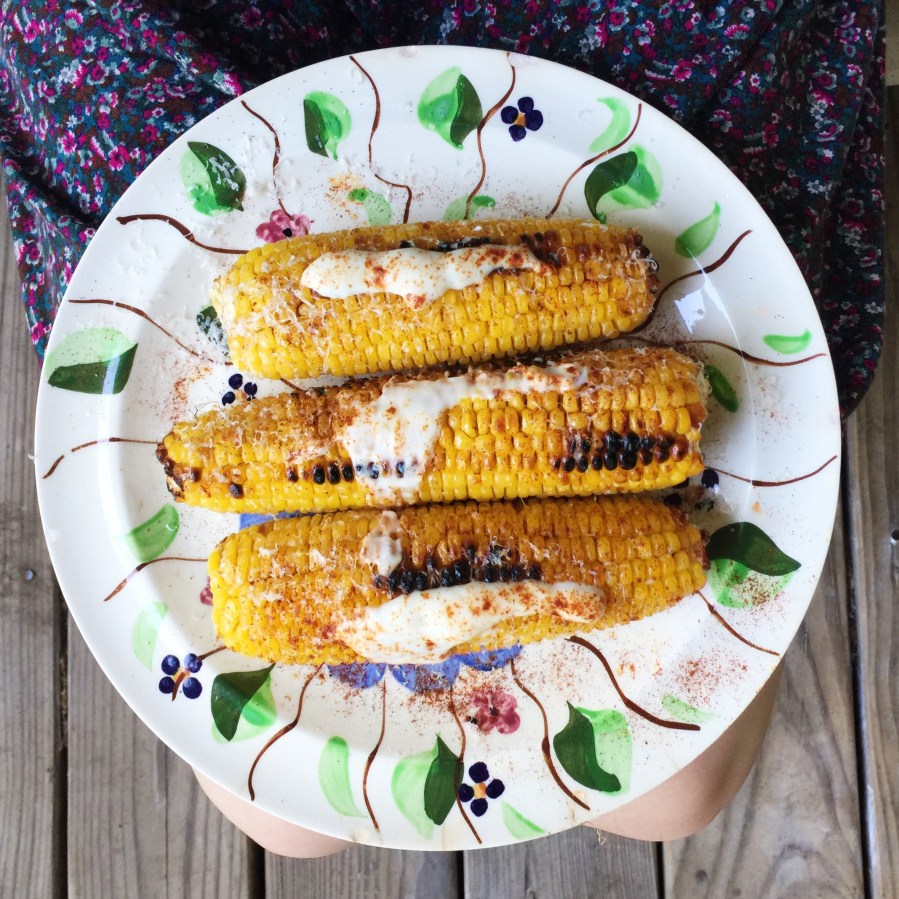
If you’ve ever looked at your buttered corn-on-the-cob and thought to yourself “wow, this is pretty boring”, then you’re ready to try Elotes, the traditional corn-on-the-cob Mexican street food. Elotes are the Chicago style hot dog of corn: more toppings = more exciting.
You only need a few things to make this simple but sassy dish:
(makes 4 servings)
4 ears of corn
1/4 C mayonnaise
1/2 C cheese (crumbled Cotija is the Mexican cheese traditionally used for this dish, but a finely grated parmesan will also do the trick)
1 tsp. chili powder
Lime wedges
That was easy. Now four simple steps and we’re done!
Pull back the corn husks and clean away the silk.
To roast the corn, heat your oven’s broiler to medium-high. Set the corn under the broiler and roast it until it crackles, turning it frequently so each side chars. I had the most luck with the oven, but you can also do this on your gas burner or in a very hot frying pan.
While the corn is still hot, slather it in mayo (a brush works best, but a spatula or spoon also works) and dust it with cheese and chili powder.
More than ever, consumers are choosing to buy locally sourced food and products. ALFN’s mission is to connect Arkansas to these farms and businesses so that everyone can enjoy locally grown goods! You might have heard that locally grown food is good for you and supports the local economy, but here are 4 more reasons to buy local food that might surprise you:
Local farms preserve open space. Having nearby farms preserves open space and keeps developers from sprawling outside of urban areas. In New York City the CENYC stated that nearly a million acres of local farmland had been covered in cement and asphalt over the past 50 years alone. Thanks to strong support for local food, Little Rock residents can enjoy green spaces like the Dunbar Community Garden, Little Rock Urban Farm, and Heifer Urban Farm.
Local foods attract tourists. A variety of farmer’s markets, local restaurants with access to fresh food, and the chance to visit local farms promotes tourism in a region.
Local food is good for the soil. Local farmers generally use more environmentally-friendly farming practices than industrial farmers, which means healthier food and healthier soil. Sustainable agriculture reduces erosion, which is responsible for the loss of 30% of the world’s arable land. It also keeps our soil and water free from harmful pesticides, fertilizers, and chemicals.
It is a safer food supply. Food traveling a long distance has a greater opportunity to be contaminated on the journey, and outbreaks become harder to trace due to the multiple points of contact in the food supply chain. The high volume demanded from industrial farms and confined animal feeding operations can mean weaker food safety standards. When buying local food take the opportunity to research the vendor you’re buying from, what their farming practices are, and (in the case of meat) what processing plant they use.




 Arkansas Local Food Network